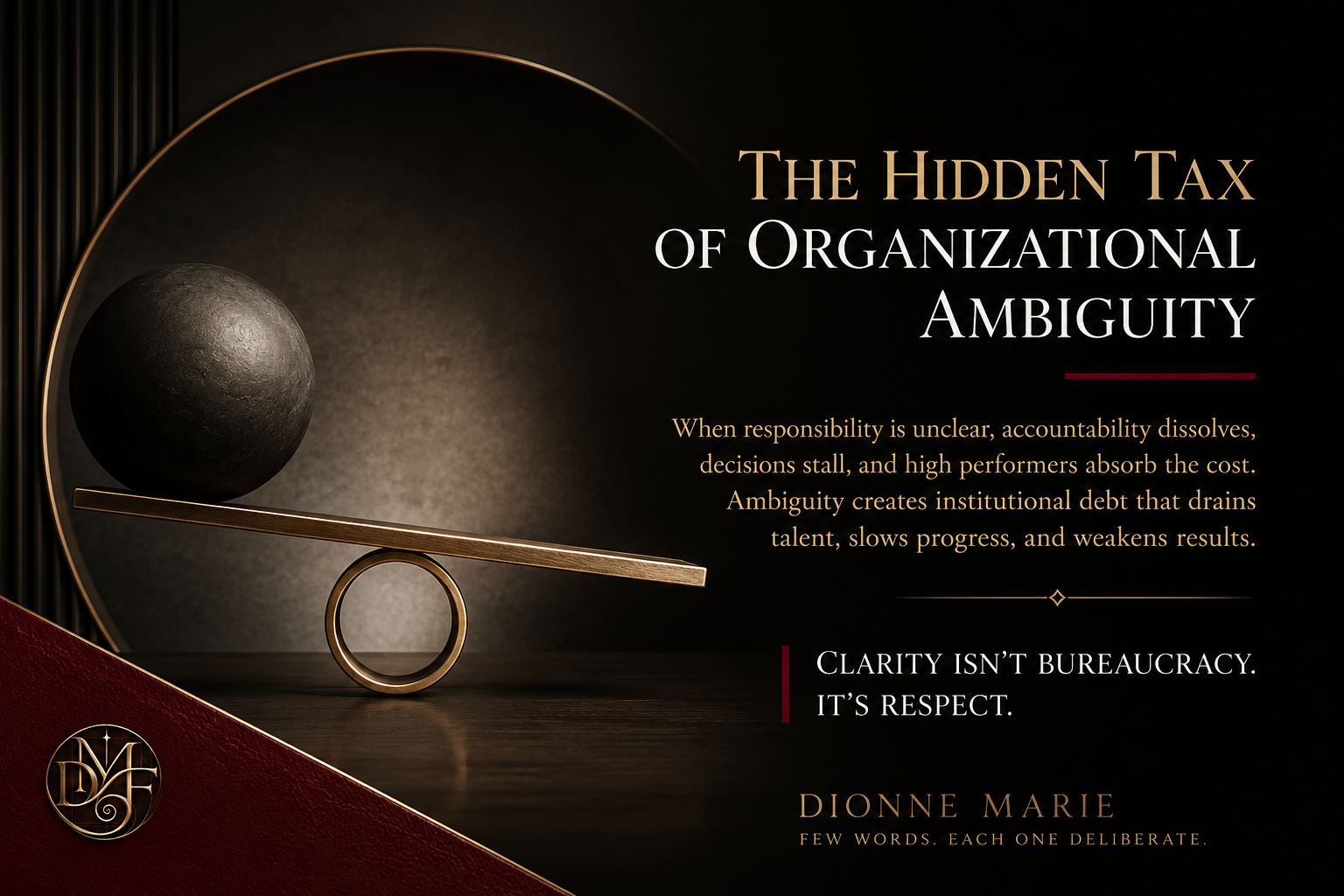
The Hidden Tax of Organizational Ambiguity
Clarity is one of the most undervalued forms of organizational capital.
Organizations rarely struggle because people are unwilling to work. More often, they struggle because responsibilities become blurred, authority becomes assumed rather than assigned, and accountability quietly dissolves into collective ownership. What appears to be a performance issue is often an architecture issue.
Ambiguity creates an invisible organizational tax. It slows decisions, encourages duplication of effort, and forces high-performing employees to compensate for structural weaknesses. Over time, those employees become the unofficial problem-solvers for every gap the organization has failed to define. Their competence masks systemic deficiencies, giving leaders the false impression that the organization is functioning well.
This pattern is particularly dangerous because it rewards the wrong behavior. Exceptional employees receive more work simply because they are capable, while unclear ownership allows others to remain peripheral to critical outcomes. Eventually, the organization begins relying on individual heroics instead of institutional discipline.
The strongest organizations recognize that human capital is fundamentally an allocation challenge. Talent should be invested where it creates the greatest strategic value and not where it repeatedly absorbs operational uncertainty. Every hour spent clarifying avoidable confusion is an hour diverted from innovation, customer experience, growth, or long-term planning.
One practical exercise can reveal hidden organizational debt: conduct an Ambiguity Audit. Review recurring responsibilities across departments and ask four questions:
Who owns this decision?
Who supports its execution?
Who provides final approval?
Who simply needs to be informed?
When more than one person believes they own a responsibility, conflict eventually follows. When no one believes they own it, important work quietly goes undone.
Clear ownership does more than improve efficiency. It reduces frustration, strengthens trust, accelerates decision-making, and allows talented professionals to focus on the work they were hired to perform. Clarity is not bureaucracy; it is one of the highest forms of organizational respect.
“The strongest organizations do not ask exceptional people to compensate for ordinary systems. They build systems worthy of exceptional people.”
Review one department each month specifically for role ambiguity rather than employee performance. Many recurring performance concerns disappear once ownership becomes unmistakably clear.
People should create value and not compensate for ambiguity.
Few Words. Each One Deliberate.
— Dionne Marie
#Leadership #ExecutiveLeadership #HumanResources #OrganizationalDesign #LeadershipDevelopment