The Organization Before the Documents
Why systems and not processes determine whether an organization can consistently produce excellence.
Most organizations do not suffer from a lack of processes. They suffer from a lack of systems. When performance becomes inconsistent, leaders often respond by documenting another process, drafting another procedure, or issuing another policy. The assumption is understandable: if people know what to do, the organization should perform better.
Yet the opposite often occurs. Documentation expands while consistency declines. Employees become overwhelmed with instructions, leaders become frustrated with compliance, and every new challenge is met with another document. The problem is rarely the documentation itself. The problem is that documentation has been mistaken for design. A process is not a system. A procedure is not a process.
Each serves a distinct purpose, but each depends on the integrity of the layer above it. Organizations that confuse these concepts often build operationally from the bottom up. They write procedures first, assemble them into processes, and only later attempt to define the system those activities were meant to support.
Exceptional organizations engineer in the opposite direction. Like an architect designing a building, they begin with the structure before writing the instructions.
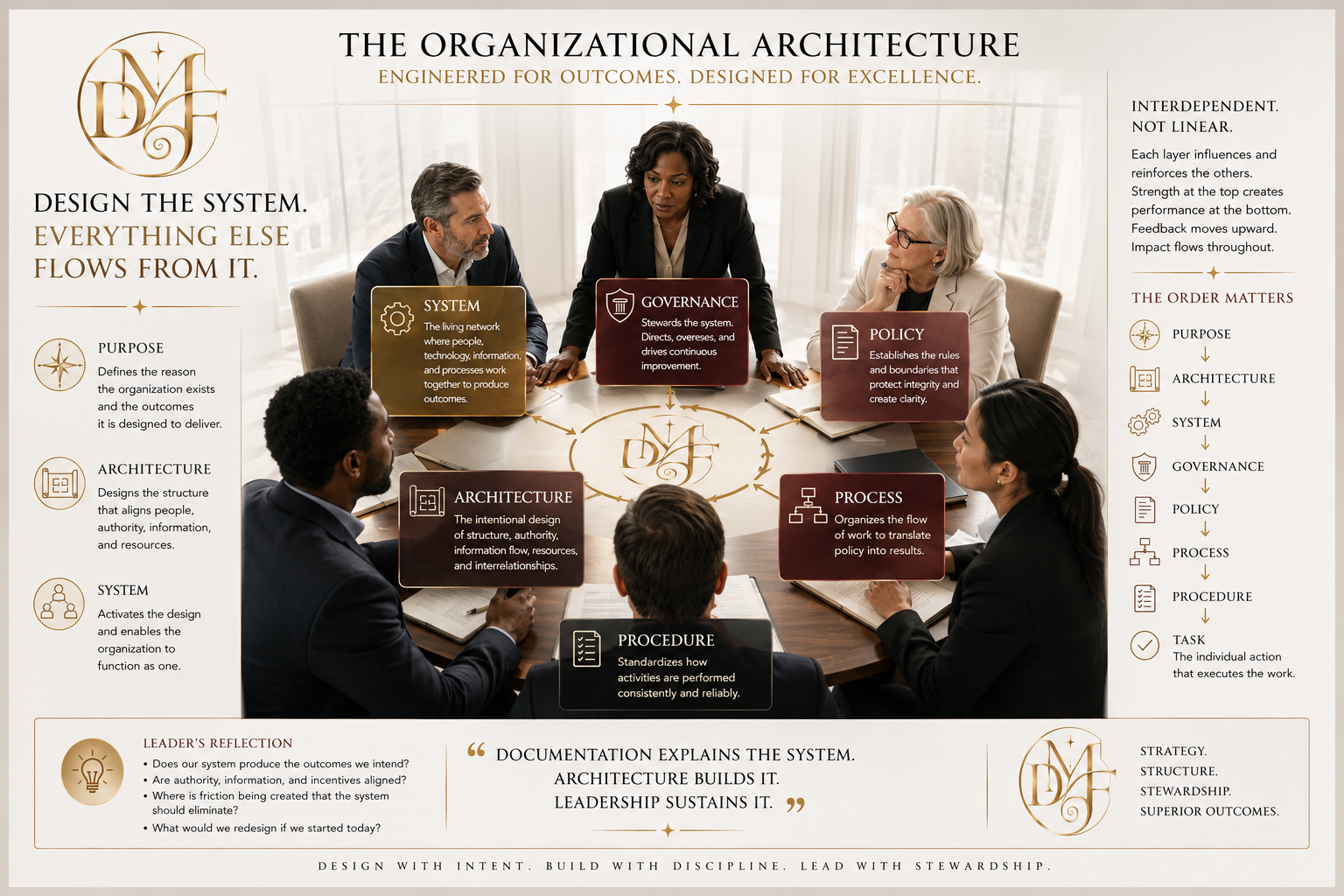
A system is the complete operating architecture of an organization. It defines how information flows, where authority resides, how decisions are made, what standards govern performance, how technology supports operations, how accountability is measured, and how feedback is used to improve results. It is the environment in which work occurs. From that architecture emerges governance the mechanisms that direct, oversee, and improve the system over time.
Governance establishes the policies that protect the integrity of the organization. Policies define what must and must not occur. Processes then translate those policies into repeatable flows of work. Finally, procedures provide detailed instructions for executing individual tasks within those processes. The hierarchy is intentional:
System → Defines how the organization functions.
Governance → Preserves and improves the system.
Policy → Establishes organizational boundaries.
Process → Organizes the flow of work.
Procedure → Standardizes individual execution.
Each layer inherits its logic from the one above it. Many organizations reverse this sequence. They begin with procedures because procedures are visible. Systems are not.
That distinction explains why so many operational improvements fail. Leaders rewrite procedures when outcomes disappoint, believing execution is the problem. Yet employees may be following the procedure exactly as written while navigating conflicting priorities, unclear authority, fragmented information, or incentives that reward different behaviors. The procedure is functioning. The architecture is not.
Consider an international airport. The airport itself is the system. Security, air traffic control, baggage handling, passenger movement, maintenance, emergency response, technology, staffing, and governance all operate as interconnected components.
Within that system exist hundreds of processes from passenger check-in to aircraft fueling. Within each process are detailed procedures explaining how individual tasks are performed. The airport does not operate safely because every employee memorized procedures. It operates because those procedures were engineered to support a coherent system.
Organizations are no different. Leaders should spend less time asking whether employees followed the process and more time asking whether the system naturally produces the behaviors and outcomes the organization expects.
That shift changes everything. Instead of auditing compliance alone, executives begin evaluating architecture. Does information move efficiently? Is authority clearly assigned? Do incentives reinforce desired behavior? Are performance measures aligned with strategic objectives? Can the organization produce consistent results regardless of who occupies a particular role?
Those questions reveal whether an organization has been documented or deliberately engineered.
“Documentation preserves consistency. Systems create it.”
Before writing your next procedure, pause and examine the architecture around it.
What system is this procedure intended to support?
Would the organization still achieve its desired outcome if every employee followed this process perfectly?
Where is the architecture creating friction that no procedure can eliminate?
Are governance, policy, process, and execution reinforcing one another—or working against each other?
Organizations do not become exceptional because they accumulate manuals. They become exceptional because every policy, process, and procedure grows from a thoughtfully engineered system designed to produce excellence by design rather than by chance.
The strongest institutions are not built by documenting more work. They are built by engineering systems that make excellent work the natural outcome.
— Dionne Marie