The Business You Build Begins Before It Exists
Most entrepreneurs believe their first responsibility is finding customers. It is not. Their first responsibility is building a business capable of serving those customers repeatedly, consistently, and intelligently.
Unfortunately, many entrepreneurs begin by selling before they begin by engineering. Revenue arrives first. Systems arrive later. Documentation is postponed. Decisions remain trapped inside the founder’s head. Every new opportunity depends on the owner’s personal involvement because nothing has been translated into an organizational capability. The result is predictable. Success creates complexity faster than the business can absorb it.
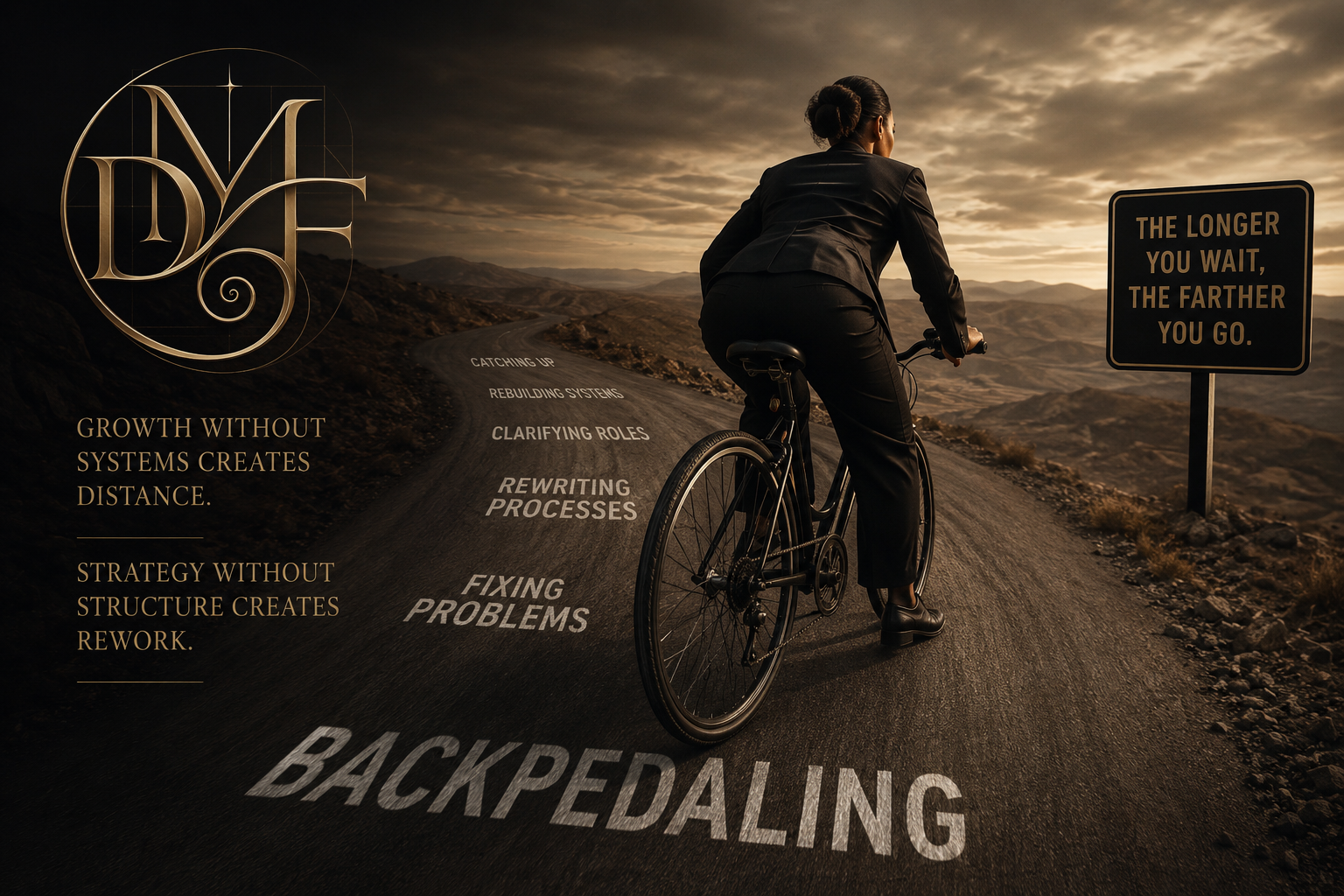
Growth then becomes an exercise in backpedaling. Founders suddenly pause expansion to organize documents, create workflows, implement software, rewrite contracts, hire operations staff, define responsibilities, and recover institutional knowledge that should have been documented from the beginning. None of these activities create new revenue, yet each becomes unavoidable because the business was never designed to support its own success.
The irony is that systems are least expensive when the business is smallest. Many founders delay creating them because they believe systems belong to large companies. In reality, large companies simply experience the consequences of having or lacking them at a greater scale. A business should never rely on memory where documentation can provide certainty.
The transition from employee to entrepreneur is not simply changing who signs the paycheck. It is changing how work is governed. Employees inherit systems. Entrepreneurs create them. That distinction changes everything.
Before hiring the first employee, signing the next client, or expanding into another market, founders should begin constructing the institutional architecture that future growth will depend upon. Several foundational systems deserve attention from the earliest stages.
The first is governance. Every business needs clearly defined decision rights, approval authority, organizational standards, and documented responsibilities. Even if one person performs every role today, documenting those roles prepares the organization for delegation tomorrow.
The second is financial management. Revenue, expenses, capital allocation, budgeting, reporting, forecasting, and cash reserves should operate according to defined policies rather than daily judgment. Entrepreneurs often mistake bookkeeping for financial management. The former records history; the latter shapes the future.
The third is operational execution. Every recurring activity should eventually become a documented standard operating procedure. Client onboarding, project delivery, purchasing, quality reviews, communications, invoicing, and follow-up should produce consistent outcomes regardless of who performs them.
The fourth is knowledge management. Every important lesson, vendor relationship, template, contract, checklist, decision rationale, and operational insight should live inside an organized knowledge repository rather than inside someone’s memory. Institutional knowledge becomes a business asset only when it survives employee turnover.
The fifth is performance management. Businesses improve what they measure. Establishing key performance indicators early allows founders to recognize patterns before problems become crises. Metrics transform management from intuition into informed decision-making.
Finally, every entrepreneur should establish a decision management system. Most founders underestimate how much organizational value disappears because decisions are undocumented. Recording significant decisions, assumptions, alternatives considered, expected outcomes, and post-decision reviews creates organizational intelligence that compounds over time. Mature institutions rarely depend on remembering why something was done. They preserve the reasoning.
Many entrepreneurs believe these systems can wait until the business grows. Experience suggests the opposite. Growth magnifies existing architecture. It does not replace it.
If disorder exists with ten customers, expansion simply creates disorder at one hundred. If decision-making depends entirely on the founder today, hiring twenty employees merely distributes uncertainty more widely. Businesses do not become organized because they become larger. They become larger because they become organized.
The founders who build enduring institutions think differently from the beginning. They recognize that every process, every document, every policy, and every standard is an investment in future capacity rather than a distraction from present revenue.
Revenue funds the enterprise. Systems preserve it. Growth attracts attention. Systems sustain confidence.
The entrepreneur’s objective is not merely to build a successful business. It is to build a business that can continue succeeding without requiring yesterday’s problems to be solved tomorrow.
The entrepreneurs who move fastest over the long term are rarely those who postpone structure, they are those who build it before growth demands it.
— Dionne Marie
#Entrepreneurship #BusinessSystems #Leadership #Operations #BusinessGrowth